A Paracaleño in Search of Gold
For someone informed of the range of craftsmanship in the Philippines, the word “Paracale” evokes images of fine artistry in gold jewelry. The town’s name is the local term for canal diggers since the place was filled with canals when the Spaniards first visited. Recorded history notes that gold was being mined in the town of Paracale, Camarines Norte as early as the mid-1500s. But hand-beaten gold accessories can be dated earlier than what the history generated by our colonizers tells us.
Ryan Rubio, born in this same town in 1982, grew up surrounded by industries and material culture born out of mining and jewelry making. Although he points out that his family was more involved in the mining and processing of metal than in the production of gold accessories. His grandfather was a mining engineer and his father was a welder. It was from his father that he was first exposed to the tools of sculpture making, an art form he started to explore only two years ago.
His memories from childhood also recall a view of the mountains surrounding the town and a few meters from their home, the waters of Pulang Daga (“daga” in Bicolano means soil) that was their playground. He has not been home for a while until his recent visits last year and this year again, in May. It was then that he was confronted by the dire condition of Paracale and the future of its people. The mountain which he once thought as a constant feature of his hometown’s landscape is now almost flat and the waters of Pulang Daga has now turned to mud, both due to rampant small- and large-scale mining. Rubio laments the irony of Paracale – its land produces the precious yellow metal but the town and its people remain poor.
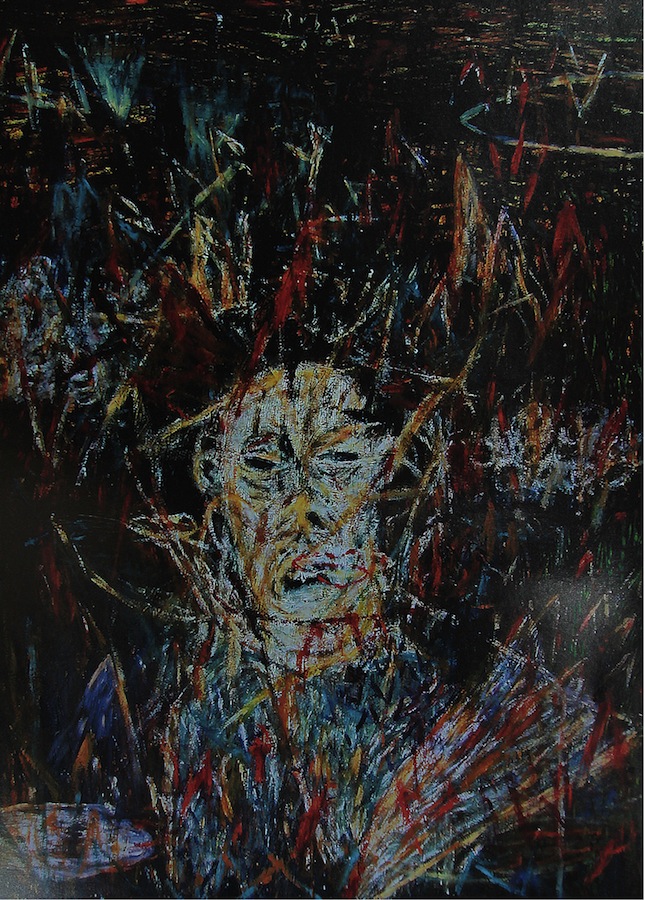
Since his last visits, Rubio began working on a series of works. The urge was almost spontaneous that he needed to retreat in his studio, completely detached from the outside world. His friends almost thought he was missing. Then a few months later, Rubio has completed Paracaleño, a suite of sculptures, mixed media works, and paintings that pays homage to his beloved hometown.
His subjects are the people and the landscape that makes Paracale distinct. People are embodied in wood, stone, clay and metal. Images of the terrain are painted in oil pigment but rendered in almost water-like washes. The local folks – Paracaleños – appear weathered yet animated in recycled wood, clay and metal parts. Rubio introduces us to local terms and the social context that are unique to small-scale mining in Paracale. Canal diggers or the magkakabod are roles taken on by young boys or even women. But more often women take on the task of the mag-aakaw. They process the gold by sifting through mud to separate the gold using wooden pans or what is called the pabirik.
Another local mining practice is the use of a makeshift raft or balsa to carry improvised machineries and tools to dig for gold and other metals underwater. The maglilidip dives into muddy waters to dig the soil only to be provided with air through a tube attached to an air pump. This practice has led to the destruction of corals and caused the waters of Pulang Daga to go murky. Fishing has also ceased to be a source of food for the town.
Rubio, however, points out it was the “absence” of the mountain in the familiar landscape that made him realize that the destruction of the environment is rampant. It was literally just in their backyard. He notes that within a year, four mining companies were given licenses to set up their own operations and this literally ate up the mountain. His oil on paper and canvas paintings are impressionistic but are far from the bright compositions characteristic of this style. His pigments are earthy and dark, the sky dim and overcast. He sought to capture the loss of life and growth in nature.
Rubio also points out how the Paracaleño’s today have chosen to just focus on mining and have neglected other sources of livelihood. Food crops are no longer being planted even in backyards and so the townsfolk have to resort to buying food from nearby towns. Copra, once a produce in Paracale, has been abandoned. Although Rubio seems to be hopeful as he channels the “guardians” or tagapag-alaga in a set of round canvas paintings mounted in coconut shells. Applied almost in drip-like strokes, his compositions recall the wax drippings formed in the folk healing practice of pagtatawas. Does this suggest an attempt to heal the land?
This is perhaps asking too much of art and of the artist. But Rubio’s works are in consonance with a global concern for the environment and leads us to assess the risks of progress. As a stakeholder and a Paracaleño, he makes us rethink the benefits and effects of mining, an issue quite timely with the recent call for a sense of responsibility to key players in the industry.
MVTHerrera
September 2012
________________________________________________________________________